
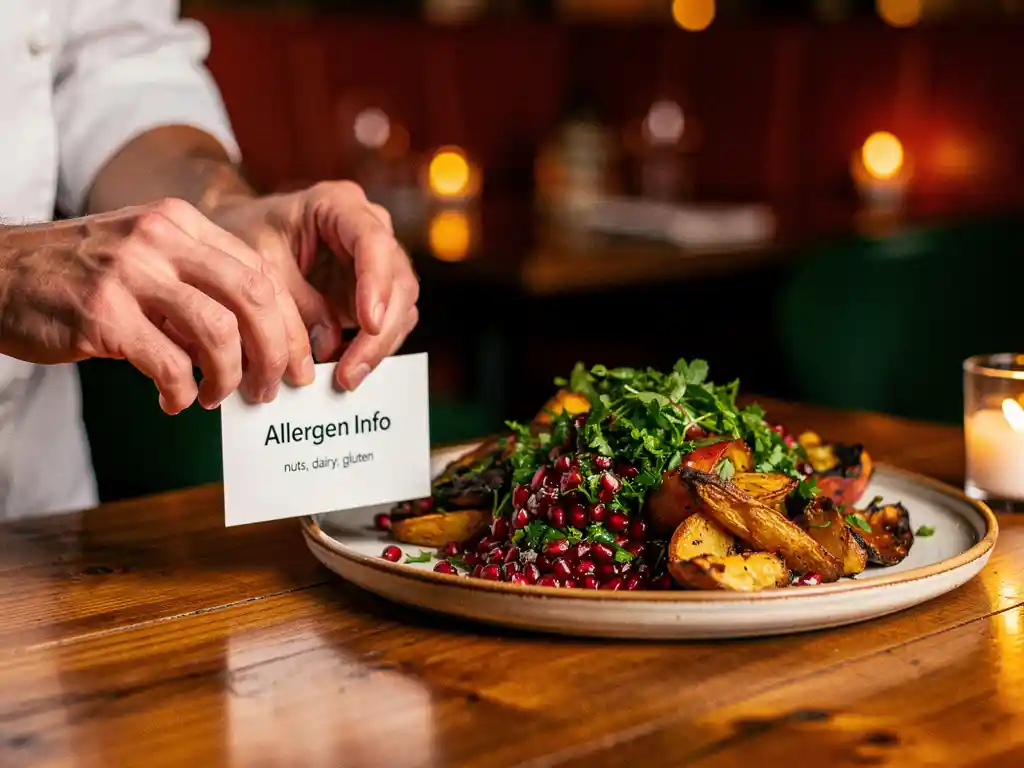
Dining with a food allergy or intolerance requires trust in the restaurant you choose. Whether you avoid gluten, have a nut allergy, or are lactose intolerant, you want to be confident that a restaurant takes your health seriously. Especially in a vibrant, diverse city like Amsterdam, where a restaurant in Amsterdam Zuidoost often works with international cuisines and a wide range of ingredients, it pays to do your research in advance.
In this article, you’ll find practical guidance for assessing whether a restaurant handles allergies professionally. From asking the right questions to recognizing red flags — here’s how to go out prepared.
Why is a solid allergy policy at a restaurant so important?
A strong allergy policy protects guests with food allergies or intolerances from reactions that can sometimes be life-threatening. For people with a severe allergy — such as an anaphylactic reaction to peanuts or shellfish — a single mistake in the kitchen can have serious consequences. A restaurant that takes this seriously reduces risks while simultaneously building trust with its guests.
Moreover, food service businesses in the Netherlands are legally required to provide allergen information. European legislation stipulates that restaurants must be able to communicate the fourteen major allergens, both verbally and in writing. A restaurant that fails to do so is not only acting unprofessionally, but also in violation of the law.
Which common allergens must a restaurant in Amsterdam Zuidoost disclose?
Every restaurant is required to provide information on the fourteen legally recognized allergens. These are gluten, crustaceans, eggs, fish, peanuts, soybeans, milk, tree nuts, celery, mustard, sesame seeds, sulfur dioxide and sulfites, lupin, and mollusks. A restaurant in Amsterdam Zuidoost with an international menu regularly works with ingredients from a wide variety of cuisines, which increases the likelihood of hidden allergens.
Think of soy sauce in Asian dishes, tahini in Middle Eastern dips, or nuts in African sauces. With a diverse menu in particular, it is all the more important that staff know exactly which allergens are present in each dish. Always ask for an up-to-date allergen card or list, as menus change frequently.
How do you recognize a restaurant that takes allergies seriously?
A restaurant that takes allergies seriously demonstrates this in several ways: staff are well trained, the menu contains clear allergen information, and procedures are in place to prevent cross-contamination. You don’t have to wait until you’re seated to assess this. Many signs are visible before you take your first bite.
Signs of a professional allergy policy
- The menu or website lists allergens for each dish
- Staff proactively ask about allergies when taking your order
- A separate allergen card is available upon request
- The kitchen uses separate cutting boards or preparation surfaces for allergen-free dishes
- Staff can refer you to the head chef for complex questions
A well-trained team knows exactly what goes into every dish and won’t hesitate to modify a dish or decline to serve it if safety cannot be guaranteed. The latter is actually a sign of professionalism, not poor service.
What are the best questions to ask restaurant staff about allergies?
The best questions are specific and focused on your particular allergy. Don’t just ask whether a dish is “allergy-free” — ask targeted questions about ingredients, preparation methods, and the possibility of cross-contamination. That way you’ll get useful answers instead of vague reassurances.
Helpful questions to ask:
- “Does this dish contain [specific allergen]?”
- “Is this dish prepared in the same pan or with the same utensils as dishes containing [allergen]?”
- “Can the chef modify this dish to make it free of [allergen]?”
- “Who can I speak to if I want more details about the ingredients?”
- “Do you have a written allergen list available?”
Pay attention to how staff respond as well. A good team member takes your question seriously, checks with the kitchen if necessary, and gives you an honest answer when something is uncertain. Uncertainty is human; a dismissive attitude is not.
What are red flags when it comes to how a restaurant handles allergies?
Red flags are signs that a restaurant doesn’t take allergies seriously: vague language, impatient staff when allergy questions are raised, and the absence of written information are the most common warning signs. If you spot these, it’s wise to proceed with extra caution or choose somewhere else.
Specific red flags to watch out for:
- Staff say “that’s probably not in there” without checking
- No allergen card is available and no one is willing to consult the kitchen
- The staff member downplays the seriousness of your allergy
- Modifications are promised but never communicated to the kitchen
- The menu changes frequently, but the allergen information is not kept up to date
Trust your instincts. If you feel that your safety is not the restaurant’s priority, it’s better to choose a place where it is.
How does an international restaurant in Amsterdam Zuidoost handle allergies?
An international restaurant in Amsterdam Zuidoost works with ingredients and preparation techniques from a wide range of world cuisines, which presents both a challenge and an opportunity when it comes to allergy policy. The challenge lies in the complexity of ingredient lists; the opportunity lies in the fact that well-trained international kitchen teams are often highly knowledgeable about what goes into their dishes.
A professional international restaurant invests in allergy training for both kitchen and front-of-house staff, maintains up-to-date allergen records for each dish, and adapts dishes where this is both possible and safe. The combination of a diverse menu and a strong allergy policy shows that a restaurant is truly committed to being accessible to everyone.
How The Traveller Amsterdam handles allergies
At The Traveller Amsterdam, we take allergies seriously because we believe everyone should be able to enjoy a culinary journey around the world without worry. Whether you join us in Amsterdam Zuidoost or in the Rivierenbuurt, we are always ready to help. Here’s how we approach it:
- Our team is trained to answer allergy questions accurately and honestly
- We maintain up-to-date allergen records for every dish
- Our international kitchen pays close attention to cross-contamination and safe preparation
- We adapt dishes wherever possible to accommodate your dietary needs or allergies
- You are always welcome to speak with one of our team members for a personal conversation about your situation
Want to make sure your visit goes smoothly? Get in touch with us in advance or browse our offerings at The Traveller Amsterdam Zuidoost and The Traveller Amsterdam Zuid. We’re happy to help, so you can focus entirely on the flavors of the world.
Veelgestelde vragen
Should I notify the restaurant of my allergy in advance, or can I do it when I arrive?
It is always advisable to notify the restaurant of your allergy in advance, for example by phone or email. This gives the restaurant time to prepare, inform the kitchen, and arrange suitable alternatives if needed. Letting them know when you arrive is also possible, but it gives staff less time to handle things carefully — especially on busy evenings.
How do I know whether a restaurant's online allergen information is reliable?
Check whether the allergen information on the website is listed specifically for each dish, rather than as a general disclaimer. Reliable restaurants update this information regularly and clearly state that menus may vary. Not sure? Call the restaurant directly and ask a specific question about a particular dish — the response will tell you a lot about their knowledge and diligence.
What exactly is cross-contamination, and how significant is the risk at an international restaurant?
Cross-contamination occurs when allergens accidentally come into contact with a dish through shared kitchen utensils, surfaces, or cooking oil. In an international restaurant with a diverse menu, this risk is higher because many different ingredients are used simultaneously. A professional restaurant has procedures in place to address this, such as separate cutting boards, clean pans, and clear communication between front-of-house and kitchen staff.
Can I hold a restaurant liable if I have an allergic reaction?
In principle, yes. Dutch and European law requires food service businesses to provide accurate allergen information. If a restaurant can be shown to have provided incorrect or incomplete information and you suffered harm as a result, liability may apply. For this reason, it is also important as a guest to ask your questions in writing or through a clear conversation, so that there is a record of communication.
What if a restaurant says it 'cannot guarantee' a dish 100%?
This is an honest and professional answer, not a red flag. A restaurant that acknowledges it cannot fully guarantee safety for a severe allergy is giving you the information you need to make an informed decision. In that case, ask whether there are other dishes where the risk can be better managed, or consider choosing a restaurant that is better equipped for your specific allergy.
Are there apps or tools to help me find allergy-friendly restaurants in Amsterdam?
Yes, there are several resources available. Apps such as AllergyEats, Find Me Gluten Free, and the Dutch version of Thuisbezorgd offer filters for dietary needs and allergies. You can also use review platforms like Google Maps or TripAdvisor and search specifically for terms like 'gluten-free', 'nut-free', or 'allergy' in other guests' reviews.
What should I do if I have an allergic reaction after visiting a restaurant?
For mild symptoms, such as itching or stomach complaints, contact your doctor or a pharmacist as soon as possible. For severe symptoms — such as difficulty breathing, throat swelling, or an anaphylactic reaction — call 911 immediately. Always make sure you carry emergency medication such as an EpiPen if you have a severe allergy, even when dining at a restaurant you trust.
Gerelateerde artikelen
- Waarom is een restaurant in Amsterdam Zuid steeds populairder bij toeristen?
- Wat is de sfeer bij een restaurant in Amsterdam Zuidoost op een doordeweekse avond?
- Wat zijn de nieuwste restaurants in Amsterdam Zuid die in 2026 zijn geopend?
- Wat zijn de fijnste terrassen in Amsterdam?
- Wat serveren restaurants in Amsterdam Zuid tijdens de lunch?